Sorbet-making for nerds

The magic number for sugar concentration in sorbet is 37%. That concentration of sugar gives the right texture (niether too icey, nor too sticky-syrupy).

When making a fruit juice sorbet, a hydrometer is an extremely helpful tool for obtaining the right sugar concentration. With a little algebra, it’s possible to account for the sugar already in the fruit juice, and thus add exactly the right amount of additional sugar to obtain 37% sugar weight/volume. (Assuming 1.4 kg sugar raises the volume by 1 litre works well.)

My approach is:

  • Cold-extract fresh fruit juice.
  • Measure specific gravity of juice.
  • Calculate required sugar addition to raise sugar concentration to 37%.
  • Add sugar to the minimum volume of juice possible required to dissolve the sugar (using half the volume of juice on hand is usually fine). Dissolve over gentle heat. (By not dissolving the added sugar in water, the juice is not diluted and flavour is maximised.)
  • Blend back the fruit syrup with the remaining juice.
  • Proceed as usual, getting as much air into the sorbet as possible, minimising the ice crystals, etc.
  • Measuring the specific gravity of pink grapefruit juice

    Posted in Sorbet, Uncategorized | Leave a comment

    Duck, Cheese, Repeat Pear

    New World Pinot Noir with duck, but which direction should the duck take? Try Asian…

    Duck

    BBQed duck, rice, pear, Indonesian jus, salad

    BBQed duck: kaffir lime leaf wrapped BBQed duck breast.
    Rice: spiced (cinnamon, ginger) sushi/glutinous rice with lemon juice.
    Pear: poached in white wine, lemon juice, touch of star anise; fried off in butter, BBQed.
    Indonesian jus: caramelised onion, duck stock, galangal, kaffir lime leaf, lemongrass, palm sugar, garlic, star anise; infused and reduced.
    Salad: carrot, celery, green bean, sushi vinegar and mirin.

    In a multi-course, in retrospect, I’d drop the salad and up the rice spice.

    Matched single blind for me:
    Lucy Margaux Jim’s Vineyard Pinot Noir 2010, Adelaide Hills, Australia
    Farr Rising Pinot Noir 2009, Geelong, Australia

    Cheese
    Composed cheese courses are heavenly. Croutons – with plenty of olive oil and salt and baked to achieve decent Maillard – with a Brie/Camembert style cheese.

    Tasmanian Heritage Red Square, poached pear, crouton, spiced walnuts


    Walnuts: roasted with sugar and cardamom.
    Pear as above.
    Tasmanian Heritage Red Square – a washed rind that clearly has significant Brevibacterium linens influence and benefits from it immensely. Most Australia Brie-style cheeses don’t include the bacterium, are naturally dominant in the creamy-lactic spectrum (probably due to the milk) and lack funky-ripeness. This cheese, when aged appropriately, is properly stinky.

    Posted in Cheese, Duck, Salad, Uncategorized | Leave a comment

    Combinations

    Shola Olunloyo continues to inspire… available ingredients influence… ideas fuse…

    Pork chop; apple-miso purée; caramel; roast fig, roast almond and Kalamata olive 'tapenade' topped with hazelnuts, grilled green capsicum/bell pepper and greens


    Pretty good with an (off-dry side of dry) Savennières.

    Posted in Apple, Bell pepper/capsicum, Fig, Greens, Nuts, Olive, Pork, Uncategorized | Leave a comment

    Coffee Roasting: Sulawesi Toraja

    I am continuing to enjoy Indonesian coffees. This is a Grade 1 wet processed bean that benefits from a slow roast at low heat (especially in the early stages and between 1st and 2nd cracks). Just into second crack here, it showed fruity (almost vinous) aromas, with rainforest floor character and caramel flavours. Low acid but not overly sweet either – great balance.

    Posted in Coffee, Uncategorized | Leave a comment

    Know your ingredients

    Prawn/shrimp intestines taste shitty, and the green core of sprouting garlic tastes vegetal-rancid. Small components can have impact; it pays to be aware of the quality of your ingredients and respond accordingly.

    Posted in Uncategorized | Leave a comment

    Easter Menu

    A hastily composed menu.

    Salmon and prawn wantons, prawn bisque
    Certainly not to the standard of this execution, but nevertheless enjoyable. This wonton filling was tighter, due to being blitzed. Unfortunately, I think the touch of added Australian cream let this bisque down.

    Australian cream just isn’t up to it’s European counterparts – for a start it’s relatively harder to find cream around 18% fat (Australian “light cream”/British “single cream”/high fat American “half and half”/French “crème légère”) that doesn’t have vegetable gums added, and the cream at >40% fat (Australian “double cream”, French “crème double”, American “double cream”/”extra heavy cream”, British “double cream”) has a texture more like British “clotted cream” (at 85% fat).
    Note the appearance of the fat globules in this bisque (emulsified with natural Australian “double cream”), and compare to the equivalent globules in the previous execution noted above (that uses British “single/double cream”).
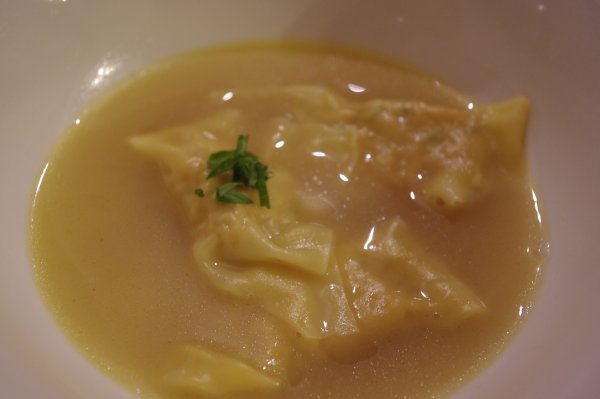
    Salmon and prawn wantons, prawn bisque

    Mi cuit salmon, pea soup, lemon oil
    A last minute dish, using left over salmon from the wonton filling, and not the best flavour combos as a result (a mint oil would be a better match – even before getting to the pea-salmon combo – but I didn’t have enough mint).

    It seems to have become standard to refer to fish cooked to between 40°C and 50°C (104°F and 122°F, respectively) as mi cuit (half/semi cooked), though the proteins have certainly denatured at these temperatures.

    Mi cuit salmon, pea soup, lemon oil

    The above two dishes were served with Bollinger Special Cuvée NV, with which they went pretty well. But then, “Champagne goes well with everything, and everything goes well with Champagne”. The wine itself had a great autolytic nose of lemon curd and toast, but was let down a little by a palate with very slightly disjointed acidity (that’s just how I feel about Bollie though), bruised apple (I tend to prefer cleaner fruit flavours in Champagne) and dilute pear flavours, and a mid-palate and finish that didn’t quite last or feel in balance. Picking hairs though, as this was good, and went well with the above dishes.

    Bollinger Special Cuvée NV

    Lamb, Puy lentils, baked aubergine, blanched leek and brocollini, lavender jus
    Puy lentils sit inside a blanched leek leaf. The eggplant/aubergine was baked with garlic, ginger, soy sauce, sesame seed oil, red wine vinegar and tarragon – a good combo and the tarragon added an intrigue. The lavender provided a twist that worked well with the lamb.

    BBQed lamb, Puy lentils, baked aubergine, blanched leek and brocollini, lavender jus

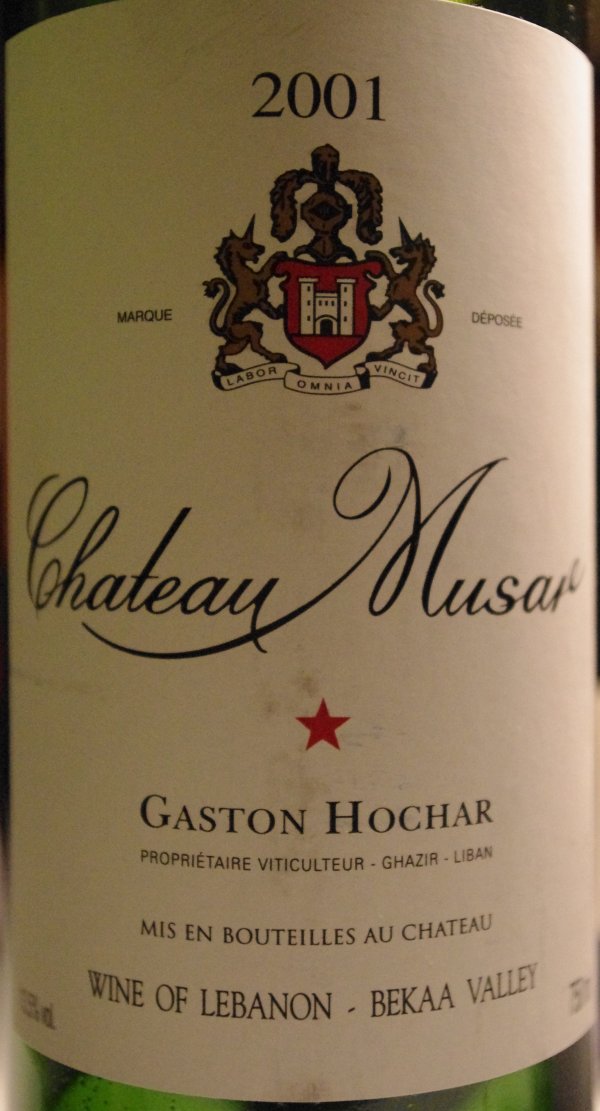
    Server with Chateau Musar red 2001. My first bottle of the 2001 vintage, and it (unfortunately) seems to be moving in the same direction since the 1998, with less VA/Brett influence. Still, lovely warm cedary, gently spiced, ripe plummy fruit (whilst still being savoury), and a smooth palate with soft acidity and great balance (without falling into the dull/sickly-smooth trap). It’s a shame not to see some goat shit here, but then Musar is subject to bottle variation and perhaps this would see a nice Brett bloom in bottle with a few more years. :-)

    Chateau Musar red 2001

    Chocolate Chantilly, white chocolate-yoghurt icecream
    Hervé This thought to develop a foam from a chocolate emulsion, working air into the emulsion as it cools (as with a Chantilly cream). It works very well, essentially creating an eggless chocolate mousse. Here, the chocolate was piped (tricky to work with as the temperature drops and the chocolate firms).

    Some chocolate (mousse) eggs were coated in powdered vanilla sugar for variety. Served with Kamozawa’s/Talbot’s white chocolate-yoghurt icecream and (not shown) roasted hazelnuts. The Greek yoghurt’s tang provides freshness, the nuts texture and flavour contrast.
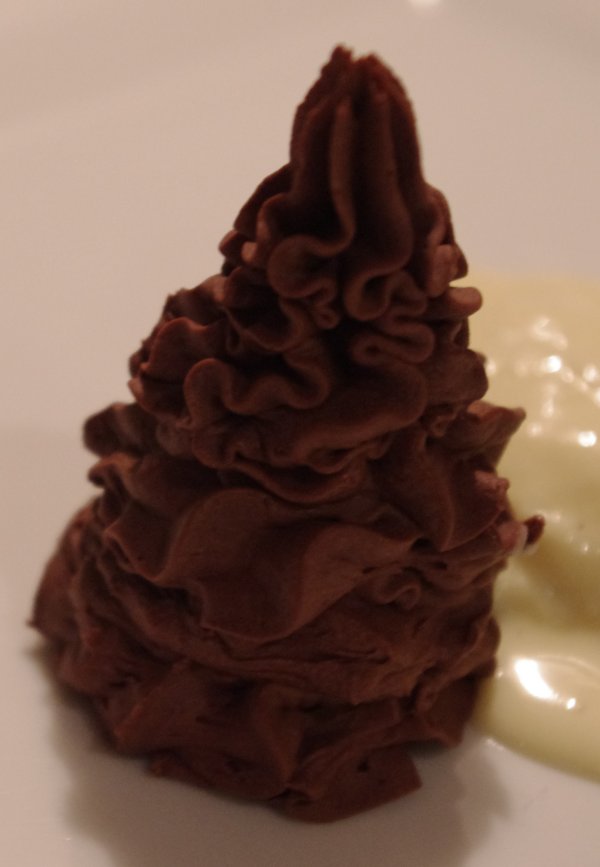
    Chocolate Chantilly, white chocolate-yoghurt icecream


    Posted in Chocolate, Fish, Lamb, Leek, Shellfish, Uncategorized | 2 Comments

    Duck and figs

    I had always been interested by Thomas Keller’s dish of five-spiced roasted lobster with Port-poached figs and duck foie gras. Finally having access to some fantastic figs, I thought to pair them with duck.

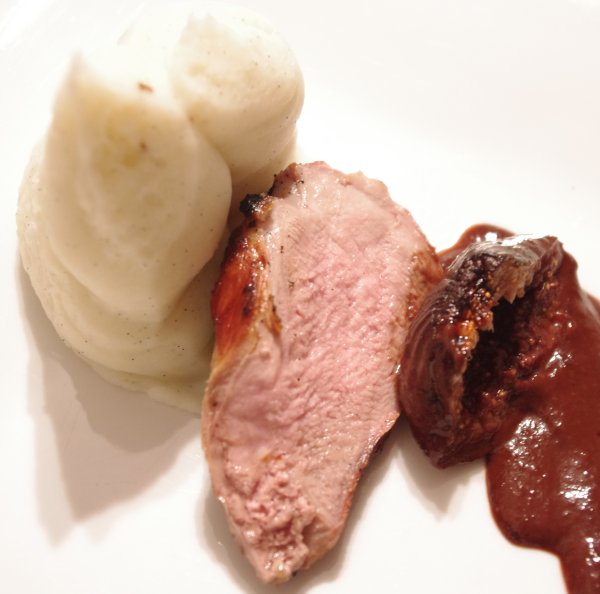
    BBQed duck, Port-poached figs, vanilla potato mash

    The figs are oven-braised in Port-style wine. A sauce is then prepared by blending some of the figs with a little bittersweet chocolate and coffee grounds, before passing through a fine seive/chinois. It’s a pretty good combo with duck, as is (John Campbell’s inspired) vanilla potato mash.

    The match with by Farr’s Tout Prés Pinot Noir 2008 (Geelong, Victoria, Australia) was not particularly good, due to the wine’s high acidity (which was a problem anyway). A great nose of lichen, forest woods and leaves, and without the volatility that so many New World Pinots of this style get; a of touch spice and great oak integration. A fantastic front palate with silky texture and perfectly balanced medium-weight. Unfortunately, from there on the acid kicks in and destroys what would otherwise be a great wine. Nevertheless, enjoyable, but perhaps not with the “sweet” flavours of duck, fig and vanilla.

    Posted in Duck, Fig, Potato, Uncategorized | Leave a comment

    An Italian Philosophy

    I have realised of late how much my recent approach has been influenced by Italian aesthetics. When short of time for haute cuisine prep, and yet aiming for multi-course menus, and having access to some high quality ingredients, it just makes sense to adopt an Italian-orientated philosophy. That means minimal intervention with the ingredients, and simpler presentations that show the diner those ingredients in a relatively unmanipulated form.

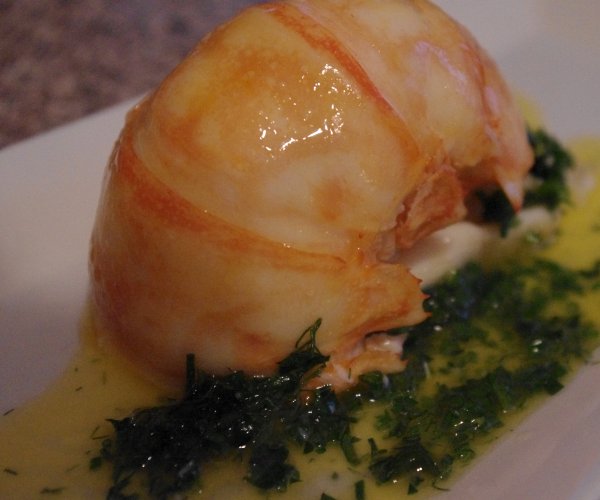
    Lobster, herb butter sauce


    Butter sauce with chives, fennel, parsley and a little lemon juice.

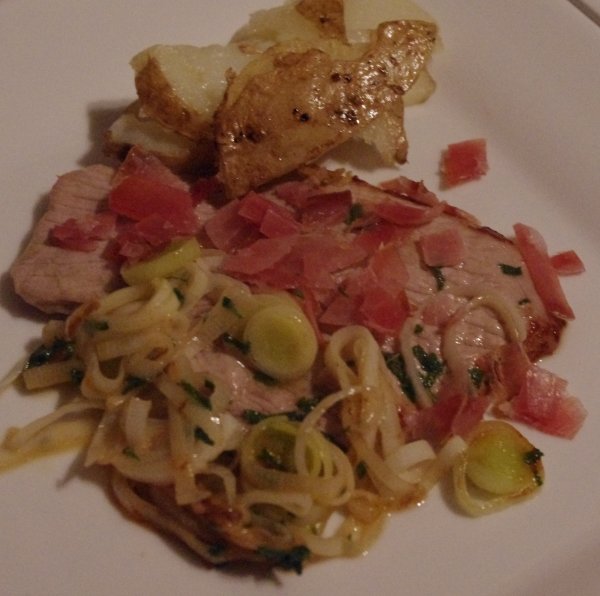
    Modified Saltimbocca: veal, leeks, prosciutto, potato


    The potatoes are par-boiled then shallow fried. Sage is essential in the butter-oil sauce, of course.

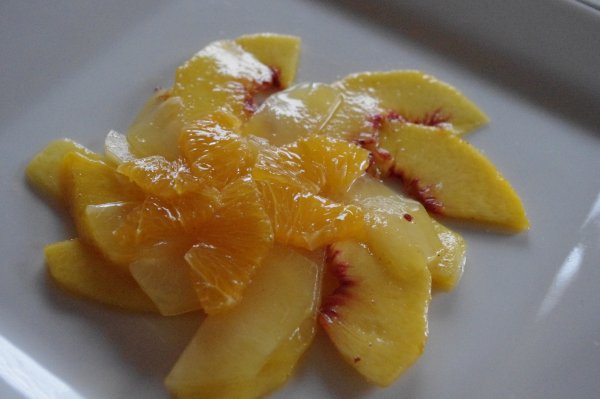
    Carpaccio of fruit


    In accordance with the philosophy, best not to obscure great fruit when you have it.
    However, combining the “Italian philosophy” with an haute cuisine philosophy begs the question: can this high quality fruit be enhanced? The answer for fruit is to:
    (i) boost the acidity (IMO, a fruit-based acidity is best, whether that be wine or citrus juice),
    (ii) boost the sweetness (but not too much – it has to be balanced), and
    (iii) cool the fruit.
    This enhances the flavour.

    Here, it’s peach, plum and tangelo “dressed” with lime juice and vanilla sugar (which, of course, dissolves; especially when ground down). In retrospect, sticking solely to stone fruits would have been better (the tangelo lost it’s grapefruit lift and became a dull citrus with this preparation).

    Posted in Fruit, Leek, Lobster, Shellfish, Veal | Leave a comment

    Christmas dinner

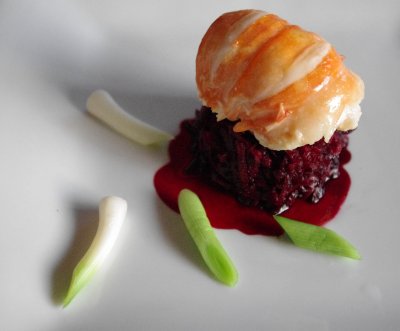
    Lobster, shredded beetroot, beetroot essence, young leeks

    Lobster, shredded beetroot, beetroot essence, young leeks

    The (unfortunately pre-cooked) lobster was warmed in beurre monté. Beetroot essence comprised beetroot juice, buerre monté, red wine vinegar, lemon juice. Blanched young/baby leeks. Fried shredded leeks (not shown) add a flavourful garnish.

    Paired with Kumeu River Matés Vineyard Chardonnay 2007 (Auckland, New Zealand), I was worried that the wine would present too much acidity, but that concern was not borne out. Pale lemony yellow, the nose showed rotting vegetation, struck flint, sweet lemon, quince, and a white floral note. The seamless palate had great balance, integration, weight (not heavy like so many Aussie Chards) and good length. To criticise, the palate showed slightly lacking flavour concentration from the mid-palate and the wine was better drunk cooler than warmer (which was a shame) – with warmth, the oak became more obvious and the quince gave way to more floral aspects. But this is very good Chardonnay. I would quite likely think it a Burgundy if tasted blind. At A$60 it represents fantastic value against the best of Australian Chardonnays.

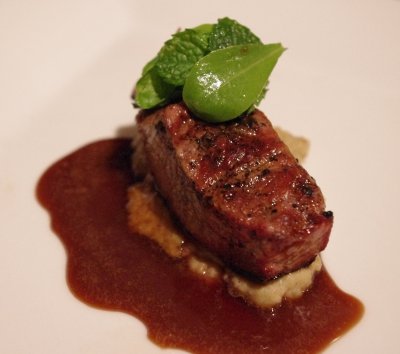
    BBQ lamb, cumin eggplant/aubergine, jus, greens

    BBQ lamb, spiced eggplant/aubergine, jus, greens

    Lamb loin (eye meat only); eggplant/aubergine creamed with yoghurt and cumin; jus based on veal, red wine and the standard aromatics; baby rocket and mint dressed in sushi vinegar and just a touch of olive oil.

    Paired with Wynns John Riddoch Cabernet Sauvignon 1988 (Coonawarra, Australia), which was slightly past its peak, but nevertheless showed a lovely nose of vegetable (like steamed snow pea), old leather boot, gentle spice box, a touch of menthol, and some fruit underneath. The palate has lovely medium weight (a refreshing 12.3% abv – why can’t more Aussie reds be picked at this kind of Baumé?!), good acidity, soft tannins, and the flavour of sour reds fruit (cranberry/redcurrant). The finish strangely holds its flavour on the front-mid palate and it’s a little short, but nevertheless enjoyable. A pleasant match with the lamb, with which the acidity, body and flavours were complementary.

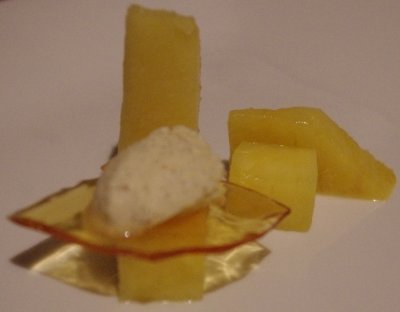
    Rum-flambéed pineapple, caramel, vanilla mascarpone

    Rum-flambéed pineapple, caramel, vanilla mascarpone


    Paired with Mount Horrocks Cordon Cut Riesling 2005 (Clare Valley, Australia), one of the best Aussie stickies IMO. Mothballs, camphour and petrol on the nose, along with iris and honeyed apricots; with wonderfully balanced palate that’s fresh, not cloying or heavy at all, and with good length.

    Posted in Beetroot, Dessert, Fruit, Lamb, Leek, Menu, Shellfish, Uncategorized | Leave a comment

    Coffee Roasting: El Salvador Finca El Carmen

    City: Ataco
    Altitude: 1300 metres above sea level
    Variety: 100% Bourbon
    Processing: Fully washed and dried on patio
    Owner: Alfaro family
    Roast: Heated up slowly to 1st crack, then cruised (slightly lower heat) to near the end of 1st crack.
    Cup: Almost buttery-smooth, ultra pure flavours of sweet milk chocolate (nice!) and caressing mouthfeel with balanced weight. This is very good, and definitely what I look for in an El Salvadorian.

    El Salvador Finca El Carmen roasted well into 1st crack

    Posted in Coffee, Uncategorized | Leave a comment